How to open a beauty salon in Poland in 2026: registration, ZUS, cash register, sanepid

A step-by-step plan for opening a beauty or hair salon in Poland: who can register, CEIDG and PKD codes, ZUS and taxes, the cash register, sanepid and client documents.
Terminka Team 10 min read
How to open a beauty salon in Poland in 2026: registration, ZUS, cash register, sanepid

You already have regular clients in Poland and want a place of your own. Opening a beauty or hair salon here involves fewer formalities than you might expect, but the order matters, especially for social security (ZUS), the cash register and hygiene procedures. Polish terms are kept in italics because you will see them on the forms.

Legal status: October 2026. This is not legal or tax advice, so go through the options with an accountant.

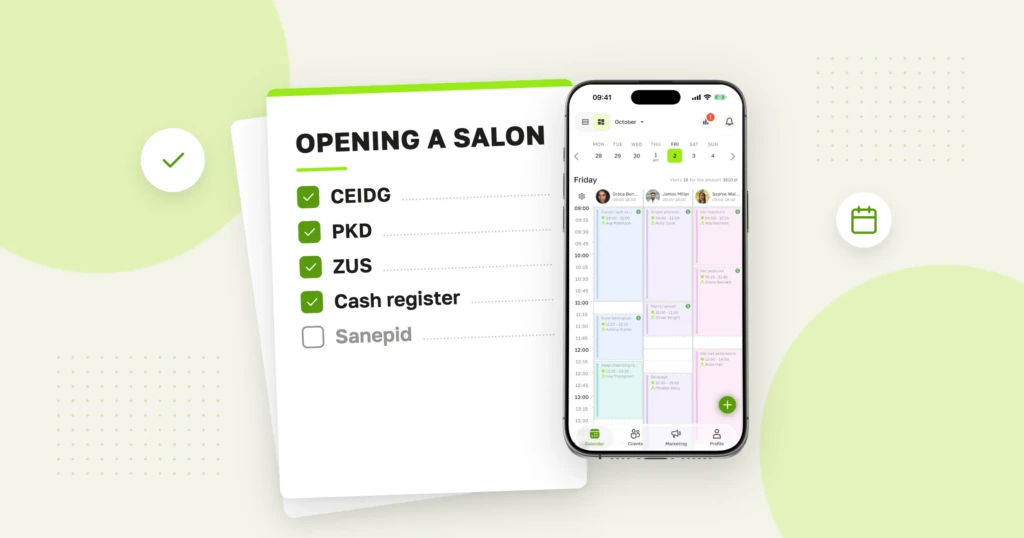
Opening a salon in Poland in 8 steps

  1. Check that your residence status lets you run a sole proprietorship.
  2. Choose a business form, e.g. a sole proprietorship (jednoosobowa działalność gospodarcza, JDG).
  3. Pick your PKD 2025 codes.
  4. Choose a form of taxation and decide on VAT together with an accountant.
  5. File the free CEIDG application.
  6. Decide on ZUS contributions.
  7. Buy an online cash register before your first paying client.
  8. Prepare the premises, hygiene procedures and client documents, then open online booking.

Can a foreigner open a salon in Poland?

Yes, though not everyone can do it as a sole proprietor. The rules below apply to non-EU citizens. The law treats EU/EEA citizens separately, so check your case on biznes.gov.pl. A non-EU citizen can register a JDG on the same terms as a Pole with one of the grounds listed in art. 4 of the Act on foreign entrepreneurs, for example permanent residence, EU long-term residence, some temporary residence permits (EU Blue Card, family reunification, marriage to a Polish citizen), refugee status or subsidiary protection, temporary protection or a Pole’s Card. The full list is on biznes.gov.pl. A temporary residence and work permit on its own is not enough. Without any of these grounds, the only route is a company such as a spółka z o.o.

Ukrainian citizens with temporary protection (a PESEL with UKR status) can open a JDG on the same terms as Poles. Since 5 March 2026, legal stay alone no longer qualifies. The EU has extended protection until 4 March 2028, while Polish national deadlines still say 4 March 2027, so check with the Office for Foreigners (UdSC).

From 1 November 2026, a foreigner filing with CEIDG must have a PESEL number. Documents for clients who live in Poland (price list, service descriptions, bills, consumer information, contracts) must be in Polish under the Polish Language Act. You may add an English version alongside.

Business form and CEIDG registration

The simplest way to start is a sole proprietorship registered in CEIDG. The CEIDG application is free and is filed online on biznes.gov.pl. CEIDG passes your data on to the tax office (NIP tax number), the statistics office (REGON) and ZUS, so one form covers all three. The entry appears by the next working day at the latest, and you may start trading on the day you file.

The online application is signed with a trusted profile (profil zaufany), a qualified signature or a personal signature. If you have none of these, send it unsigned and sign it at a town or municipal office within 7 days. Online filing through a proxy is not possible.

Unregistered activity

While you are still testing the waters, you can work without registering. Unregistered activity (działalność nierejestrowana) covers revenue that stays within 225% of the minimum wage in every quarter, which in 2026 means PLN 10,813.50 per quarter. It is open to people who have not run a business in the last 60 months, though not to some foreigners, so check your case on biznes.gov.pl. Once you exceed the limit, the activity counts as a business from that day and you have 7 days to file with CEIDG. According to biznes.gov.pl, hair and beauty services still need a cash register.

PKD codes for a beauty or hair salon

New businesses use the PKD 2025 classification:

PKD 2025 code What it covers
96.21.Z Hairdressing: washing, cutting, colouring and styling hair, shaving and beard trimming
96.22.Z Beauty care and other cosmetic services: manicure, pedicure, permanent make-up, hair removal, facial massage, aesthetic cosmetology without medical qualifications
96.23.Z Spas, saunas and steam baths: day spas, tanning salons, slimming treatment salons and relaxation massage
96.99.Z Other personal services, including tattoo and piercing studios

Therapeutic massage has a different code (86.95.Z). An old PKD 2007 code may be used no longer than until 31 December 2026, so check your code in CEIDG before the end of the year.

ZUS: three stages for a new salon

The first two stages are for first-time founders, or people returning after at least 60 months, who do not work for a former employer they were employed by this year or last year doing the same work.

  • Start-up relief (ulga na start), 6 months: six full months without social insurance, Labour Fund and Solidarity Fund contributions. A month you start mid-way does not count. The health contribution is paid from day one, and to use the relief you register with ZUS for health insurance only within 7 days, with a code starting 05 40. The relief is optional. While you use it, nothing goes towards your pension and there are no sickness or accident benefits.
  • Reduced ZUS (preferencyjny ZUS), 24 months: for the next 24 full calendar months, social contributions are based on 30% of the minimum wage, PLN 1,441.80 in 2026. Sickness insurance is voluntary (2.45% of the base).
  • Mały ZUS Plus, not in the first year: contributions based on income, not available in your first year or during reduced ZUS. Last year your business must have run for 60+ days with revenue up to PLN 120,000 (in 2026). From 2026 it can be used for at most 36 months in any 60.

The health contribution (składka zdrowotna) depends on your tax form: 9% of income on the tax scale, 4.9% on the flat tax, and a fixed amount in one of three revenue bands on the lump sum. The amounts change every year and are published on zus.pl.

Taxes: tax scale, flat tax or lump sum

There is no option that suits every salon. If you choose nothing, the tax scale applies. In 2026:

  • Tax scale (skala podatkowa): 12% of income up to PLN 120,000 a year and 32% above that. Thanks to the tax-reducing amount of PLN 3,600, about PLN 30,000 of income is in practice tax-free. A bill changing the scale from 2027 went to the Sejm in September 2026.
  • Flat tax (podatek liniowy): 19% of income.
  • Lump-sum tax (ryczałt): charged on revenue with no deduction of costs, usually 8.5% for hair and beauty services. A new business can choose it whatever its revenue in the first year (check the conditions).
  • Tax card (karta podatkowa): not available to new businesses.

VAT

Salons can use the small business VAT exemption for sales up to PLN 240,000 a year (as of 2026), pro rata if you start mid-year. It does not exempt you from the cash register. VAT payers charge a reduced rate on hairdressing (8% in 2026). Beauty services are not on the reduced list, so as a rule the standard rate applies (23% in 2026). Both rates are temporary, so check them before your first VAT invoice.

Cash register from the first service

As a general rule, a business can do without a cash register until its sales to private individuals exceed PLN 20,000 a year. Salons are not covered by this rule. A Ministry of Finance regulation of 17 December 2024 expressly removes hairdressing, beauty and cosmetology services from every exemption. You therefore need a register from the first service a private client pays for, whatever your turnover. Sales to a company that takes an invoice do not need the register.

Hair and beauty salons must use an online cash register (kasa online). Buying one qualifies for relief of 90% of the net price, up to PLN 700 (as of 2026). Its conditions are set by art. 111 of the VAT Act, so check them with your accountant.

Premises and sanepid: what actually applies

  • There is no separate regulation for salons. The 2004 Health Ministry regulation on hair, beauty, tattoo and wellness premises stopped applying on 2 January 2012 and nothing replaced it. Requirements quoted “by paragraph” in older guides are not law today.
  • Art. 16 of the Act on preventing infections applies. If treatments break the skin, you must follow infection-control procedures for tools, sterilisation, skin disinfection and decontamination of rooms and equipment. The district sanitary inspector can review them on request.
  • The Chief Sanitary Inspector (GIS) published recommendations for the beauty sector in 2026. They are not a regulation, but your own procedures can easily be built on them: washable surfaces that withstand disinfectants, a sink with hot and cold water, soap and disinfectant dispensers and disposable towels, single-use tools for one client only, and reusable tools disinfected, cleaned and sterilised, preferably in a steam autoclave or by an outside firm.

You do not need sanepid approval to open a salon. A sanitary opinion on your premises is available on request but is not required by law. Stations give different answers on whether you must notify them that you have opened, so ask your district station (PSSE). The PSSE supervises salons and may inspect yours after opening. The Warsaw PSSE classifies infectious waste from salons under code 18 01 03*, to be handed over to a licensed collector. Check also whether you need to register in the BDO waste database.

Client documents

Before your first client, prepare salon terms and conditions, a client record card, a consultation form, a treatment consent form and GDPR information for clients, with Polish versions for clients who live in Poland. Clients can also sign them on a phone, as shown on the client card and consents page. Client records come with the Solo plan, and after signing up you get 14 days of all features for free.

Opening budget: what to count

Costs depend on the city, premises and services, so there is no single figure. Get quotes for rent and deposit, refurbishment (water, sink, ventilation), equipment, an autoclave or sterilisation contract, the cash register, products and disposables, signage, an accountant, ZUS for the first months and infectious waste collection. Keep some money aside for the months while your diary fills up.

First clients: Google, Instagram and online booking

Clients find salons on Google Maps and Instagram. Set up your Google Business Profile, put an online booking link in your Instagram bio and move your bookings out of the paper diary; our 48-hour rollout guide shows how. The free salon software plan is enough to start: Terminka Free costs PLN 0 and covers 1 person (including the owner), 1 location and 30 appointments a month. The online bookings page shows how the calendar and booking page work. If you are considering a platform that takes payments from clients, read what DAC7 means too.

Frequently asked questions

How much does it cost to open a beauty salon in Poland?

It depends on the city, premises and services. CEIDG registration itself is free, and the budget list above covers the rest.

Do I need a qualification to open a salon?

No Polish law requires a diploma to open a beauty or hair salon, and cosmetologist is neither a regulated nor a medical profession here. Because it is not regulated, you do not need a foreign diploma recognised to run your own salon.

Do I need a cash register from day one?

Yes, if private clients pay you from day one. Salons do not get the PLN 20,000 exemption.

Can I run a salon without registering a business?

At first, yes, as unregistered activity, as long as revenue in any quarter stays under 225% of the minimum wage (PLN 10,813.50 in 2026) and you have not run a business in the last 60 months. You still need a cash register.

Which PKD code is right for a beautician?

Under PKD 2025, manicure, pedicure, permanent make-up, hair removal and non-medical cosmetic treatments come under 96.22.Z. Hair salons use 96.21.Z, spas and tanning salons 96.23.Z, tattoo studios 96.99.Z.

Legal status: October 2026. Amounts and rates marked “in 2026” change every year. Check the current figures on biznes.gov.pl and zus.pl and make tax decisions with your accountant.
How to open a beauty salon in Poland in 2026: registration, ZUS, cash register, sanepid

A step-by-step plan for opening a beauty or hair salon in Poland: who can register, CEIDG and PKD codes, ZUS and taxes, the cash register, sanepid and client documents.

Terminka Team 10 min read
How to open a beauty salon in Poland in 2026: registration, ZUS, cash register, sanepid

You already have regular clients in Poland and want a place of your own. Opening a beauty or hair salon here involves fewer formalities than you might expect, but the order matters, especially for social security (ZUS), the cash register and hygiene procedures. Polish terms are kept in italics because you will see them on the forms.

Legal status: October 2026. This is not legal or tax advice, so go through the options with an accountant.

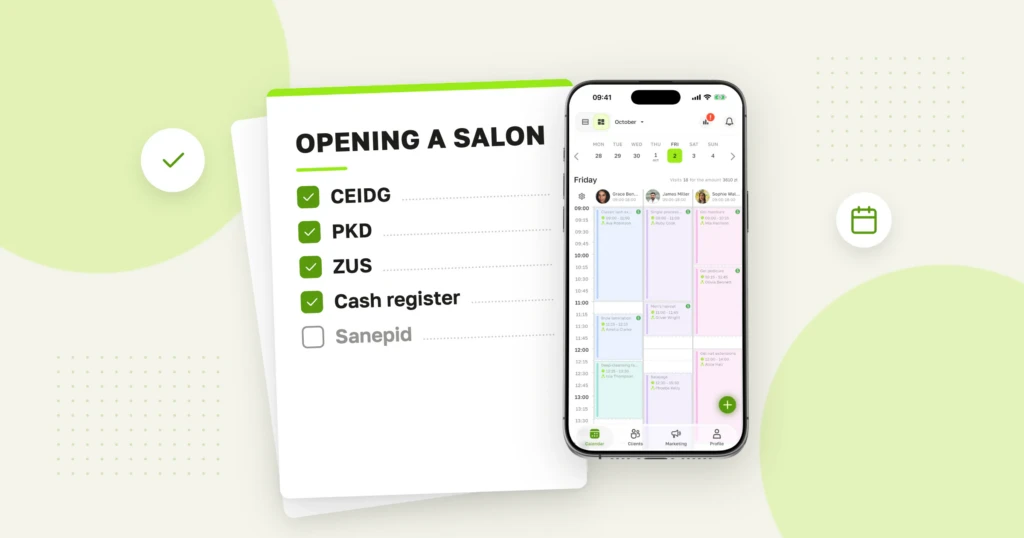
Opening a salon in Poland in 8 steps

  1. Check that your residence status lets you run a sole proprietorship.
  2. Choose a business form, e.g. a sole proprietorship (jednoosobowa działalność gospodarcza, JDG).
  3. Pick your PKD 2025 codes.
  4. Choose a form of taxation and decide on VAT together with an accountant.
  5. File the free CEIDG application.
  6. Decide on ZUS contributions.
  7. Buy an online cash register before your first paying client.
  8. Prepare the premises, hygiene procedures and client documents, then open online booking.

Can a foreigner open a salon in Poland?

Yes, though not everyone can do it as a sole proprietor. The rules below apply to non-EU citizens. The law treats EU/EEA citizens separately, so check your case on biznes.gov.pl. A non-EU citizen can register a JDG on the same terms as a Pole with one of the grounds listed in art. 4 of the Act on foreign entrepreneurs, for example permanent residence, EU long-term residence, some temporary residence permits (EU Blue Card, family reunification, marriage to a Polish citizen), refugee status or subsidiary protection, temporary protection or a Pole’s Card. The full list is on biznes.gov.pl. A temporary residence and work permit on its own is not enough. Without any of these grounds, the only route is a company such as a spółka z o.o.

Ukrainian citizens with temporary protection (a PESEL with UKR status) can open a JDG on the same terms as Poles. Since 5 March 2026, legal stay alone no longer qualifies. The EU has extended protection until 4 March 2028, while Polish national deadlines still say 4 March 2027, so check with the Office for Foreigners (UdSC).

From 1 November 2026, a foreigner filing with CEIDG must have a PESEL number. Documents for clients who live in Poland (price list, service descriptions, bills, consumer information, contracts) must be in Polish under the Polish Language Act. You may add an English version alongside.

Business form and CEIDG registration

The simplest way to start is a sole proprietorship registered in CEIDG. The CEIDG application is free and is filed online on biznes.gov.pl. CEIDG passes your data on to the tax office (NIP tax number), the statistics office (REGON) and ZUS, so one form covers all three. The entry appears by the next working day at the latest, and you may start trading on the day you file.

The online application is signed with a trusted profile (profil zaufany), a qualified signature or a personal signature. If you have none of these, send it unsigned and sign it at a town or municipal office within 7 days. Online filing through a proxy is not possible.

Unregistered activity

While you are still testing the waters, you can work without registering. Unregistered activity (działalność nierejestrowana) covers revenue that stays within 225% of the minimum wage in every quarter, which in 2026 means PLN 10,813.50 per quarter. It is open to people who have not run a business in the last 60 months, though not to some foreigners, so check your case on biznes.gov.pl. Once you exceed the limit, the activity counts as a business from that day and you have 7 days to file with CEIDG. According to biznes.gov.pl, hair and beauty services still need a cash register.

PKD codes for a beauty or hair salon

New businesses use the PKD 2025 classification:

PKD 2025 code What it covers
96.21.Z Hairdressing: washing, cutting, colouring and styling hair, shaving and beard trimming
96.22.Z Beauty care and other cosmetic services: manicure, pedicure, permanent make-up, hair removal, facial massage, aesthetic cosmetology without medical qualifications
96.23.Z Spas, saunas and steam baths: day spas, tanning salons, slimming treatment salons and relaxation massage
96.99.Z Other personal services, including tattoo and piercing studios

Therapeutic massage has a different code (86.95.Z). An old PKD 2007 code may be used no longer than until 31 December 2026, so check your code in CEIDG before the end of the year.

ZUS: three stages for a new salon

The first two stages are for first-time founders, or people returning after at least 60 months, who do not work for a former employer they were employed by this year or last year doing the same work.

  • Start-up relief (ulga na start), 6 months: six full months without social insurance, Labour Fund and Solidarity Fund contributions. A month you start mid-way does not count. The health contribution is paid from day one, and to use the relief you register with ZUS for health insurance only within 7 days, with a code starting 05 40. The relief is optional. While you use it, nothing goes towards your pension and there are no sickness or accident benefits.
  • Reduced ZUS (preferencyjny ZUS), 24 months: for the next 24 full calendar months, social contributions are based on 30% of the minimum wage, PLN 1,441.80 in 2026. Sickness insurance is voluntary (2.45% of the base).
  • Mały ZUS Plus, not in the first year: contributions based on income, not available in your first year or during reduced ZUS. Last year your business must have run for 60+ days with revenue up to PLN 120,000 (in 2026). From 2026 it can be used for at most 36 months in any 60.

The health contribution (składka zdrowotna) depends on your tax form: 9% of income on the tax scale, 4.9% on the flat tax, and a fixed amount in one of three revenue bands on the lump sum. The amounts change every year and are published on zus.pl.

Taxes: tax scale, flat tax or lump sum

There is no option that suits every salon. If you choose nothing, the tax scale applies. In 2026:

  • Tax scale (skala podatkowa): 12% of income up to PLN 120,000 a year and 32% above that. Thanks to the tax-reducing amount of PLN 3,600, about PLN 30,000 of income is in practice tax-free. A bill changing the scale from 2027 went to the Sejm in September 2026.
  • Flat tax (podatek liniowy): 19% of income.
  • Lump-sum tax (ryczałt): charged on revenue with no deduction of costs, usually 8.5% for hair and beauty services. A new business can choose it whatever its revenue in the first year (check the conditions).
  • Tax card (karta podatkowa): not available to new businesses.

VAT

Salons can use the small business VAT exemption for sales up to PLN 240,000 a year (as of 2026), pro rata if you start mid-year. It does not exempt you from the cash register. VAT payers charge a reduced rate on hairdressing (8% in 2026). Beauty services are not on the reduced list, so as a rule the standard rate applies (23% in 2026). Both rates are temporary, so check them before your first VAT invoice.

Cash register from the first service

As a general rule, a business can do without a cash register until its sales to private individuals exceed PLN 20,000 a year. Salons are not covered by this rule. A Ministry of Finance regulation of 17 December 2024 expressly removes hairdressing, beauty and cosmetology services from every exemption. You therefore need a register from the first service a private client pays for, whatever your turnover. Sales to a company that takes an invoice do not need the register.

Hair and beauty salons must use an online cash register (kasa online). Buying one qualifies for relief of 90% of the net price, up to PLN 700 (as of 2026). Its conditions are set by art. 111 of the VAT Act, so check them with your accountant.

Premises and sanepid: what actually applies

  • There is no separate regulation for salons. The 2004 Health Ministry regulation on hair, beauty, tattoo and wellness premises stopped applying on 2 January 2012 and nothing replaced it. Requirements quoted “by paragraph” in older guides are not law today.
  • Art. 16 of the Act on preventing infections applies. If treatments break the skin, you must follow infection-control procedures for tools, sterilisation, skin disinfection and decontamination of rooms and equipment. The district sanitary inspector can review them on request.
  • The Chief Sanitary Inspector (GIS) published recommendations for the beauty sector in 2026. They are not a regulation, but your own procedures can easily be built on them: washable surfaces that withstand disinfectants, a sink with hot and cold water, soap and disinfectant dispensers and disposable towels, single-use tools for one client only, and reusable tools disinfected, cleaned and sterilised, preferably in a steam autoclave or by an outside firm.

You do not need sanepid approval to open a salon. A sanitary opinion on your premises is available on request but is not required by law. Stations give different answers on whether you must notify them that you have opened, so ask your district station (PSSE). The PSSE supervises salons and may inspect yours after opening. The Warsaw PSSE classifies infectious waste from salons under code 18 01 03*, to be handed over to a licensed collector. Check also whether you need to register in the BDO waste database.

Client documents

Before your first client, prepare salon terms and conditions, a client record card, a consultation form, a treatment consent form and GDPR information for clients, with Polish versions for clients who live in Poland. Clients can also sign them on a phone, as shown on the client card and consents page. Client records come with the Solo plan, and after signing up you get 14 days of all features for free.

Opening budget: what to count

Costs depend on the city, premises and services, so there is no single figure. Get quotes for rent and deposit, refurbishment (water, sink, ventilation), equipment, an autoclave or sterilisation contract, the cash register, products and disposables, signage, an accountant, ZUS for the first months and infectious waste collection. Keep some money aside for the months while your diary fills up.

First clients: Google, Instagram and online booking

Clients find salons on Google Maps and Instagram. Set up your Google Business Profile, put an online booking link in your Instagram bio and move your bookings out of the paper diary; our 48-hour rollout guide shows how. The free salon software plan is enough to start: Terminka Free costs PLN 0 and covers 1 person (including the owner), 1 location and 30 appointments a month. The online bookings page shows how the calendar and booking page work. If you are considering a platform that takes payments from clients, read what DAC7 means too.

Frequently asked questions

How much does it cost to open a beauty salon in Poland?

It depends on the city, premises and services. CEIDG registration itself is free, and the budget list above covers the rest.

Do I need a qualification to open a salon?

No Polish law requires a diploma to open a beauty or hair salon, and cosmetologist is neither a regulated nor a medical profession here. Because it is not regulated, you do not need a foreign diploma recognised to run your own salon.

Do I need a cash register from day one?

Yes, if private clients pay you from day one. Salons do not get the PLN 20,000 exemption.

Can I run a salon without registering a business?

At first, yes, as unregistered activity, as long as revenue in any quarter stays under 225% of the minimum wage (PLN 10,813.50 in 2026) and you have not run a business in the last 60 months. You still need a cash register.

Which PKD code is right for a beautician?

Under PKD 2025, manicure, pedicure, permanent make-up, hair removal and non-medical cosmetic treatments come under 96.22.Z. Hair salons use 96.21.Z, spas and tanning salons 96.23.Z, tattoo studios 96.99.Z.

Legal status: October 2026. Amounts and rates marked “in 2026” change every year. Check the current figures on biznes.gov.pl and zus.pl and make tax decisions with your accountant.